Frankly, I lack the words to talk about Satoshi Kon’s passing; there are others who have said and will say things more eloquently. Instead, I offer you a diversion: FLCL.
I meant to write this post a while back, but never go around to it. Somehow, it’s been a very long, and a little bit of a crazy summer. Without many noticing, the 10th anniversary of a certain anime came and went in late April. You probably know it by one of it’s many names – FLCL; Furi Kuri; Fooly Cooly. I love FLCL. I’ve watched it so many times over the last decade that I’ve lost track.
I’m not sure where to start talking about FLCL. Every time I watch it, it seems to reveal something new to me. My first watch was at age 13: a year after I had gotten into anime; a year after its first airing in 2000. I had just started making websites for fun; a few fledgling anime sites. On my travels around the internet, I encountered a site dedicated to an anime called FLCL. I was intrigued: there was a company out there, 5 years before the anime ‘craze’ would hit North America, releasing DVDs in Japan subtitled, and in proper english, no less! Without knowing much more, knew I had to see it for myself, if just for purposes of supporting such a company. And so, FLCL became one of the first 10 anime I watched. Since then, I’ve rewatched it often. On occasion, I’ve felt compelled to watch during certain (looking back, key) moments in my life. Sometimes I wonder if the ripple effect of watching something so highly regarded so early in my time as a fan still influences my tastes now.
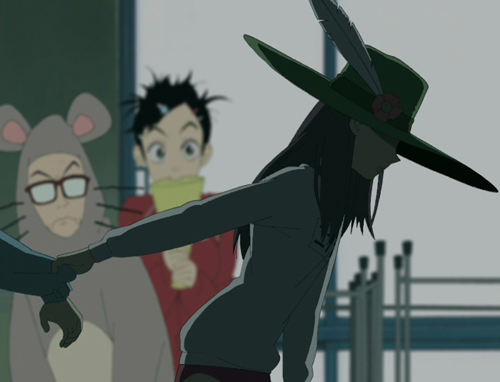
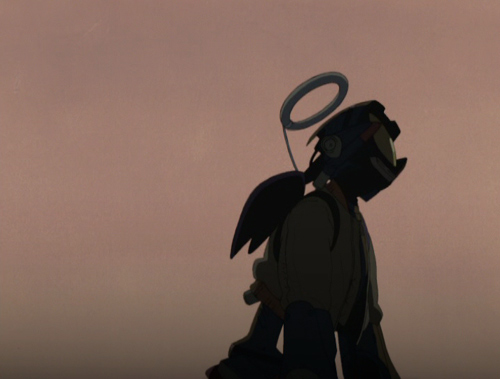
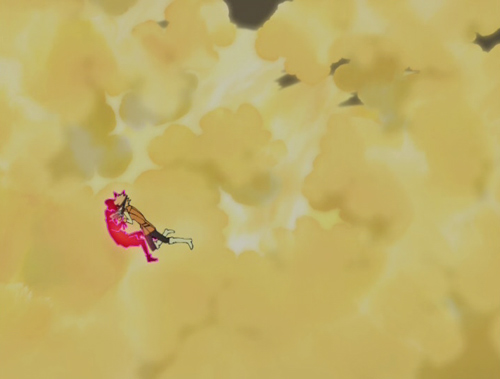
It’s often described as an anime about adolescence, but that’s a blanket statement. Naota is twelve years old, on the brink of his teenage years; experiencing his last summer as an elementary school student and child. Adolescence, moreover, is a topic so multivariate that it can’t be captured by any one series, let alone a 6-episode OVA. FLCL is about the cusps; about limits. Ninamori pretends to be mature for the entire series in regards to her parents; only to overreact towards her classmates in relation to the play. Mamimi spends the entire series on the edge of ‘overflowing’. Even Canti spends the series at a limit of a different kind, unable to live to his full potential, continually searching for minute pieces of red metal to become whole again. Naota himself is at the brink of adulthood; and acts sour due to the extreme constraints placed on him by virture of being a child.
All of the characters break through this, and it manifests in both physical and emotional ways: Ninamori cuts her hair and “cries her eyes out” to her parents. Mamimi stops lamenting the town she hates and leaves, camera in hand. Canti dons a halo and wings, jumping off a building to become closer to what he was. And Naota, in love with Haruko, fully becomes the object of her desire: Atomsk, the Pirate King.
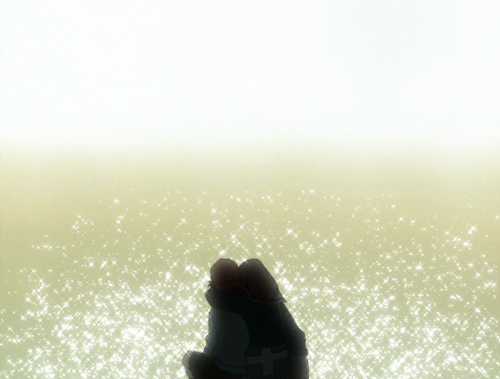
In the end, though, none of these efforts are enough. For all her crying, we never know what happens to Ninamori’s parents; either way the decision was never hers to begin with. Mamimi seems to have met with some success in photography, Naota considerably less in wooing Haruko. Ten years later, and the scene is now infamous: a boy holding a Rickenbacker guitar, amidst concrete and a sand-colored sky. The show’s final moments see Naota in a middle school uniform, black and somber. Ninamori’s comment at this moment is apt: it doesn’t suit him at all. His body is still a child’s; his pants are too long. Summer is over. They’re all only halfway there, but ‘there’ isn’t a destination so much as it is a moving target, much like Atomsk is for Haruko.
So here’s to the last 10 years, FLCL. I’m glad you were made.
The town where nothing ever happens: FLCL & I
16 responses to “The town where nothing ever happens: FLCL & I”
-
S’funny, this was one of my first anime shows as well, althought that was sometime around 2003-2004. My final year of uni coincidentally, so I wonder if I subconsciously picked up on the sensation of being on the edge of one part of life and about to move on into the unknown.
People rave about the ‘crazy’ nature of the show but few seem to remember its more sedate and tender moments, which is a shame because those parts have the most to say. Similarly, the comedy element for me was the thematic, quiet, ironic variety rather than its trademark slapstick and wordplay. One good example is Naoto’s declaration of how Mabase is a boring town where ‘nothing ever happens’: it’s punctuated by that enormous gush of steam from an iron-shaped building. The comic timing is pitch-perfect but so subtle you only laugh at its oddness afterwards.
The frenetic nature of the show does of course mean that it’s endlessly rewatchable…one of those series that takes on a slightly new meaning each time, yet retains what you loved about it the first time around. NGE has a similar effect, but this did it better I think. Looking back, for me Gainax’s finest moments were Wings of Honneamise, Gunbuster and FLCL, which means their next classic is long overdue. Shame their high-water mark is a decade old already.-
I agree very, very strongly about the quieter moments of the show having more to say. If anything my current ‘reading’ of the show dictates that the entire robot part of the plot was just allegory, or an extended metaphor for the madness that is about to hit the kids’ physiology and emotions.
Evangelion does things in… a different manner, in the sense that it really has one point that it’s trying to communicate, and that simply becomes clearer with rewatches. FLCL, to me, is tackling a far more diverse set of issues. I’d honestly include Kare Kano in that list of GAINAX’s finest moments, however – but that’s just me. It’s a company that’s changed significantly in the tone and type of anime it’s produced in the last 10 years, but I don’t think anything I’ve seen come out of them is outright bad. But yes, it would be wonderful to see another tour-de-force OVA from them soon 🙂
-
-
I used to be really passionate about FLCL too and also watched it countless times this decade. However, nowadays it just seems pretty “okay.” Don’t wanna be a downer so won’t go in depth. None the less I am glad it was made, cause I did watch it over and over and over again. This is certainly a show that I have memorized scene by scene and listening to the ost alone has also drain countless hours. Arguably the defining anime in fandom this decade.
-
Listening to the OST always fills me with nostalgia for the show. It seems to be one that’s stuck with many people, as well.
-
-
I wouldn’t say the show is ‘about’ adolescence but for me FLCL has always been about that precious thing we sometimes forget as we enter adulthood. I think the message of FLCL can be summed up nicely by ‘You are a FooL for trying to be CooL and CooL for just being a FooL’, which I wrote in more detail in other place so I’ll stop here.
Man we need more crazy anime like this…I loved TTGL because it had the kind of energy FLCL emitted, but I still appreciate FLCL more for its sense of poetic ambiguity.-
Yes, yes, more crazy anime! The problem is that crazy anime becoming commercial successes is very hit-and-miss: I don’t think Gainax forsaw FLCL going as far as it did, for example. The folks who ran Cartoon Network’s Toonami(?) block famously refer to FLCL as “the coolest show we’ve ever aired”. Arguably, there’s better, crazier anime out there, but they don’t seem to sell and thus it’s hard for them to get made.
But now I’m approaching a topic one could do a dissertation on, so 🙂
-
-
It’s difficult to get to the bottom of what makes FLCL so good. I still can’t separate it from its soundtrack, which is glorious and only seems to get better every time I watch the show. (This reminds me, I need to rewatch FLCL at some point, too!)
One thing you didn’t mention here and that’s probably important to Naota is his absent brother, who he seemed to idolise until he left, resulting in the Naota we find at the beginning of FLCL, a boy desperate for someone or something to believe in. And then Haruko shows up 🙂-
You should rewatch FLCL. I’m a huge proponent of rewatching things (as I’m sure you’ve figured out by now) if only because anime, by virtue of being broadcast on TV is a combination of words, sounds, and image. The first time we watch things (particularly because we watch them subbed, and thus spend a huge portion of our consciousness reading) is often on the words-and-narrative portion, when truly, two-thirds of the meaning lies in the other two portions.
This was going to be a way longer entry, but the end felt so nice that I just decided to leave off. What I think is fascinating is what a large character Tasuku is without even being there. On the note of things gained in the rewatch, tasuku is the root form of the verb ‘save’ or ‘rescue’. Moreover, every time Naota thinks about his brother, the sound of a plane flying overhead is played. Actally on this note, I tend to think of Haruko’s role as more symbolic/allegoric than anything – she’s less a character and more an idea. Likewise, Canti is more a symbol than anything. I think he’s a symbol for Naota’s brother, actually. Canti helps around the house, is good at baseball and Mamimi loves him. There’s a scene where Naota, crouching over to protect Mamimi calls out to his brother to save him and Canti appears, actually. Epsiode 2 or 3, I think.
-
-
That point about repeated watching revealing new aspects of FLCL neatly explains why it was such a big deal to me. I’m in the group who watched in while at uni, and it really led me into other anime because of having that feeling of confusion develop into a heady excitement on a second viewing.
Learning to love FLCL felt like a re-discovery of animation. Much like Kon’s films, it’s something tailor made for the medium. And so fun! I’ve always enjoyed they way the manga shows a sort of alternate version where FLCL is made ‘hard’, but it’s got to be the balance of fun and layering which makes the anime a masterpiece.-
Where I think FLCL excels in comparison to Tengen Toppa Gurren Lagann is in it’s balance of fun and layering, as you call it. You can’t have upward momentum without moments of quiet and vice versa. The quieter, more introspective parts of the show exist in balance with the bat-shit intergalactic robot wars, and their plots and metaphors interplay in a way that’s entirely entertaining to think about.
-
-
FLCL was hard for me to digest when I first watched it. It was paced in a way that I just wasn’t ready for. Still I’ve always loved how distinctive the show was. T imagery, for example the giant iron, was just crazy awesome.
-
Nobody’s ready for FLCL the first time. It’s kind of like riding a roller coaster, though – you can’t describe it to someone who hasn’t been on one, and you need to experience it for yourself to decide whether you like it or not. The second time you go in, though, knowing something of what to expect (and that you won’t die) you begin to notice the finer details of the situation, and it becomes way more enjoyabl
-
-
I’ve said it before (well, not here), but if someone asked me for a short list of anime they should watch, I’d usually tailor it to what I thought they would be interested in, e.g., I wouldn’t put K-ON!! on a a horror or suspense fan’s list. But FLCL would be the exception. I would put it on everyone’s, except maybe my mother’s. It can be watched for the subtleties everyone’s talked about here or you can watch it purely for the “holy shit!” moments.
-
Repeated viewings help take the edge of the holy shit moments, however. That hopsital scene loses its novelty after a couple (but it’s pretty great the first few times!) The subtle moments, however, just get better with time 🙂
-
-
Like bateszi mentioned, that soundtrack is just stellar. The combination of sound and visual shiftiness is what initially drew me in to FLCL. My first experience was around my first year in uni, but I felt like where I was in life didn’t matter for this series. There’s appeal and meaning on more than one level, and I think that’s why it offers such a great rewatch value (it’s also super efficient in terms of time X satisfaction).
Your point about limits, I really like that. I think in my own mind I perceive limits as less a stopping point, and more a place where normality ends and chaos begins, but the most interesting place is points and lines where the two converge. The finale of FLCL expresses the inflection points of the core characters so amazingly; they are there at that point in time (limits change), and from the brief acquaintance we have with the characters to that final close, the feeling and emotional charge felt at the limit speaks much to the power of this series.
I wish I rewatched it more often ^_^ -
One of the greatest animes ever. I thought the lenght of the series would upset me, but after watching it I was more than happy with the end result. My favorite part however I think was in the last episode when Naota and Canti came came to save Mamimi, but she kept on calling out for Naotas brother. And he yells” Listen! Im Naoto!”. Dont know why, but that part was awsome.


Leave a Reply