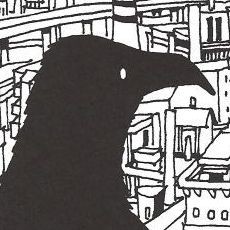
If you haven’t done yourself the favour of reading the original Sailor Moon manga, I suggest you drop whatever stigmas or preconceptions you have of the series and find yourself a copy. Naturally, it suffers from the cliches it helped to establish: baddies-of-the-moment, elaborately named attacks, and a penchant for all the bad parts of 80s women’s fashion. Coupled with the toxic sweetness of Mamoru and Usagi’s relationship, if you go in expecting anything less than the crown jewel of the magical girl genre, you’ll be going in horrendously underprepared. That said, the manga has its merits, and Sailor Moon is definitely one of those “read the manga, skip the anime” type affairs. Any fan of really, really well-drawn and well-paced manga should read Sailor Moon.
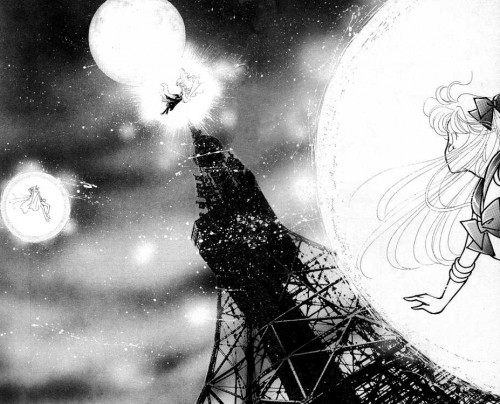
On the note of the anime, the fact that they managed to squeeze 162 episodes out of a mere 52 chapters should give you a hint as to the concentration of the manga: each chapter is a glorious 50+ page affair, and the entire first anime series, R is concluded in scarcely 12 chapters. Naoko Takeuchi’s art starts out good, if a little stiff. By the end of those initial 12 chapters, her art reaches a level in many ways untouchable by other shoujo mangaka to this day.
It is a rare thing for an illustrator of any kind to be as skilled in one style as another – a huge part of illustrating professionally is defining one’s own “style” (and for better or worse, sticking to it.) Takeuchi displays as much ability with her black and white illustrations as she does with her color ink washes; and her use of lines conveys both extreme motion and a sense of acute stillness, all within the same illustration. In her manga spreads, a similar display of extreme skill . Panel lines do more than simply divide space; they direct the energy of the page. In doing so, Takeuchi controls entire chapters down to a pinpoint, though the initially “messy” and “flowy” nature of her art would have you think otherwise.
It’s hard to appreciate what Naoko Takeuchi has done, from our current standpoint. While the age of the manga, at almost 20 years old(!) is a factor in this, it is the reach of the manga hampers us. Because Sailor Moon is so iconic, it’s hard to see past the blond dumplings, and even harder not to recall the awful dub. It’s hard not to think about the silly fangirls, badly made merchandise, and men cosplaying as the scouts when thinking about the series. Because it was the introduction to anime for so many, it’s hard not to think of it in a jaded, colored way. As fans, we pass it by for reasons which have nothing to do with the quality of the manga itself. If you can do look past these things, the reward is immense: a journey on the scale of Gurren Lagann, a love story to give Cinderella a run for its money, and the manga that started a movement.
Seeing the forest through the trees with Sailor Moon
12 responses to “Seeing the forest through the trees with Sailor Moon”
-
Watching Utena (not forgetting Princess Tutu) has really pushed me into a fascination with the shoujo aesthetic in recent times, as well as the very shoujo-esque look of recent series like Toward the Terra and Casshern Sins, too. Even still, these huge shoujo franchises like Sailor Moon (and the more realistic Nana) have remained largely unexplored depths to me. As such, and since it has your seal of approval, I’m now really excited about reading this and getting a taste of one of the most well-known Japanese shoujo stories going. I really like the images used in this post, too 🙂
-
One thing I’d correct you on in this comment is swathing all of shoujo together – after all, Yuki Urushibara, mangaka of Mushishi is technically a shoujo/josei mangaka. And I don’t think I need to point out how vastly that differs from, say, Skip Beat. On that same note, Moyoco Anno is also a shoujo mangaka – though her visuals are more shounen than Sailor Moon’s by far, thematically there’s nowhere else a manga like Sakuran, or even Hataraki Man could really belong.
Towards the Terra is a shoujo (or josei) series actually, despite its plot. I’ve got the graphic novels 🙂 Keiko Takemiya, the mangaka, is considered to be one of the more influential mangaka of the last 30 years, if simply for the issues she examines in her work and the boundaries she pushes – mostly having to do with sexuality. The Towards the Terra manga is well worth the read as well, really (you’ll likely find it under “To Terra” as opposed to Towards the Terra, however.)
In terms of the shoujo aesthetic however, perhaps the most interesting specimen is CLAMP. Whereas Takemiya falls more under the Masaaki Yuasa category of envelope-pushing (but not entirely mainstream), CLAMP took many of the themes and issues that she and her contemporaries to a more mainstream audience. If you’re looking for recommendations from the CLAMP camp, RG Veda, Tokyo Babylon, X/1999 and… hmm, Clover are on the more josei side of things, and rounding out more of their “classic” style (it’s changed significantly in their more recent works). Wish and Card Captor Sakura are quite good as well, but their recent works haven’t quite been to my tastes.
Finally, on the note of NANA: everything Yazawa Ai does is great, but read Paradise Kiss. I dunno, I have a post’s worth of things to say about Yazawa Ai’s particular aesthetic, so I’m just going to stop here.
-
-
“we pass it by for reasons which have nothing to do with the quality of the manga itself”
I’m guessing the main reason is it’s availablity! The early english release are OOP, the only decent group scanlating it has released 12 chapters over 5 years! Only way to completely read it now is low quality scans of the early english releases, it really needs a new release so more fans can actually give it a go, I’d certainly pay money for an english release of the Japanese 2nd editions (their cover art is awesome!).
When you say “Super R is concluded in scarcely 12 chapters” do you mean R or Super S? there is no Super R…-
Correction made 😉
I don’t think you should let low quality ever scare you away. But I suppose I say this because, when I started watching anime, “digi subs” meant that someone had ripped his VHS tapes at 320×240 and compressed it to about 30mb – and that was considered “reasonable” quality. The english translations of the manga, frankly, are all right – aside from the slightly irksome name translations (Darrien Shields/Bunny) I can’t say I have a problem with them. Moreover, since I haven’t made the effort to go and buy the manga (I’m sure it’s available), I don’t feel I have the right to complain 🙂
-
-
Although that picture up top screams Sailor Moon (to most a rather negative connotation) theres a sense of beauty, innocence and wonder to it that I struggle to find in today’s many derivative shoujo offerings. The art and lines are just so terrific, so pretty and soft, strictly feminine, lovely.
I grew up watching this as a child so right its now its nothing more than a distant memory. I never thought of watching/reading it again, even while knowing how huge of an influence it has had on the anime industry. But the thought of reading the mange while ignoring and placing all cliched misconceptions on the back burner does sound rather interesting. I’ve been told the best things are usualy found where one does not expect them 🙂
And you seem to be a Yazawa Ai fan? I look forward to your future posts! -
Sailor Moon definitely suffers from that sort of over-familiarity; much like Gundam Wing, Dragonball, and Evangelion, it was I think a big gateway anime for most viewers from the 90s – and there are definitely a lot of subtleties you miss as a young or first-time viewer.
I must say though, the art in the manga has certainly aged very well, given it’s age! The art nouveau styling and composition could give any modern shoujo manga a run for it’s money.-
I agree @ Gundam Wing. Honestly, Endless Waltz is one of the high points of the franchise, and the entire Wing series is a really interesting watch. Moreover, it was a groundbreaking thing here in North America – they played Just Communication, man! I used to tune in just to hear the song :).
-
-
Anything in particular about the anime that makes you recommend skipping it? I haven’t really watched much of it (and I haven’t read any of the manga yet) but most of the criticism of Sailor Moon I’ve heard has been reserved for the American anime adaptation, which involved a lot of cuts/censoring. It wouldn’t surprise me that the manga is far better than the anime, I was just wondering what about the anime prevents you from recommending it.
-
Hmm, where to begin? My encounter with the anime is through the dub. Just like Bleach and Naruto however, it was animated as it was being written – leading to tons of filler, some really, really bad 80s fashion and scenes being drawn out far longer than they should. Moreover, it suffers some production ups and downs. While the up’s are certainly high (Kunihiko Ikuhara directed 2 of the anime series) the downs are what you would expect: sloppily drawn or jaggedly animated episodes at random, general budget skimping etc. Also, frankly, her art just didn’t translate well (see below for more.)
***
As to why the manga over the anime – I’ve been thinking about this quite alot since I replied to bateszi (re: the “stillness” of shoujo manga) and I’ve come up with a tenative hypothesis as to this phenomena. Avoding the issues of character and plot (rather, working on the assumption that both shounen and shoujo manga deal with these in essentially equal measure), there is one difference which makes… all the difference :).
Shounen manga is in many ways centered around situations – who’s fighting whom, where the journey will take them, how they need to train, who killed what, etc. As such, the shounen aesthetic, with its simpler lines is geared towards communicating action. The shading (volume) of objects is more realistic, so as to give a sense of the reality of a situation (or in turn, the irrationality/fantasy of a situation) with the form of characters and objects distorting to show motion and other actions within the situation. Naturally, it’s easy to animate a situation – particularly when the manga often offers a well-framed panel-by-panel account of who’s moving where and doing what. Morever, nothing like a good dogfight at 20+ fps.
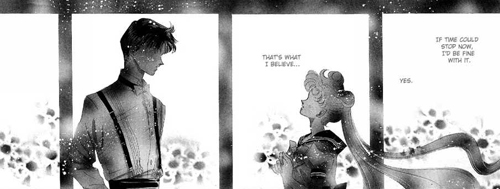
Shoujo manga on the other hand, is centered around explicit moments – see the last image in the post, for example. A kiss, a transformation, fun times with friends and the type of things that make you think “I wish this would never end”. As such, its art dedicates itself to preserving those details. Hence “expressive” or highly detailed and precisely-lined hair, abstract screentoning and shading. A focus on the details of a moment, an abstract portrayal of a series of events and heavy 1st-person narration mark the style. Perhaps “stillness” wasn’t the word I needed, but crystallized – because of an overwhelming desire to freeze a moment, shoujo manga almost never animates well, regardless of budget. To animate well, they need to simply lines, compounded with the fact that it takes a really, really good director to animate “stillness” (animating stillness is essentially a paradox, after all), without things looking cheesy, overdone, or underdone. Hinano displays this nicely. There are exceptions, of course – Princess Tutu and Utena to name two – but these are the exceptions, and not the rule. Moreover, while both have complementary manga, these manga were essentially separate works from the anime, as opposed to source material as is the case with shounen. the Utena manga was done in parallel with the anime by Chiho Saito (the character designer) but follows a slightly different plot, and the Princess Tutu one after the fact. As for anime like Honey & Clover (or Towards the Terra) – which animated beautifully, by the way – the manga at the very least equals, if not exceeds in some ways the anime (though the anime is excellent.)
-
-
I guess you should never judge a manga by its anime … seems like a lot of quality manga try to do too much or too little with the print media when they move into animation.
A quality anime interpretation of shoujo manga is hard to come by though. What about Vampire Knight? That was a quality visual interpretation imo. -
You’ve managed to get me interested. Well, actually, I’ve been interested ever since I found Black Dog’s Sailor Moon doujins, but so far it’s been weak interest, I just wanted to see what kind of a story it is. But now, I’m seriously considering checking it out, expecting something actually worthy of reading.
-
Great blog! Do you have any tips and hints for aspiring writers? I’m hoping to start my own website soon but I’m a little lost on everything. Would you advise starting with a free platform like WordPress or go for a paid option? There are so many options out there that I’m totally overwhelmed .. Any ideas? Thanks a lot!


Leave a Reply